
Understanding Energy Storage in the UK
According to this report from the Renewable Energy Association, there were numerous projects funded by the LCNF programme in the UK back in 2016.
In Figure 3-1 of the report, several energy storage projects are outlined. I summarised these projects in a table showing that the total power from these initiatives amounted to 16.55 MW, with a storage capacity of approximately 28 MWh.
Comparing TWEFDA with Existing Projects
When we compare this with the TWEFDA Association, we find that there are 6 ESWave devices generating about 5 MW each, with a peak capacity of 15 MW. This results in a total potential generation of 90 MW. Each ESWave has a capacity of 2 MWh, leading to a total storage capacity of 12 MWh for all six devices. Additionally, the central platform, which is part of a more advanced project, could function as a storage unit with a capacity nearing 8 MWh.
This means that the entire TWEFDA Association could potentially generate 90 MW with a total storage capacity of 20 MWh, which translates to around 13 minutes of power at maximum output.
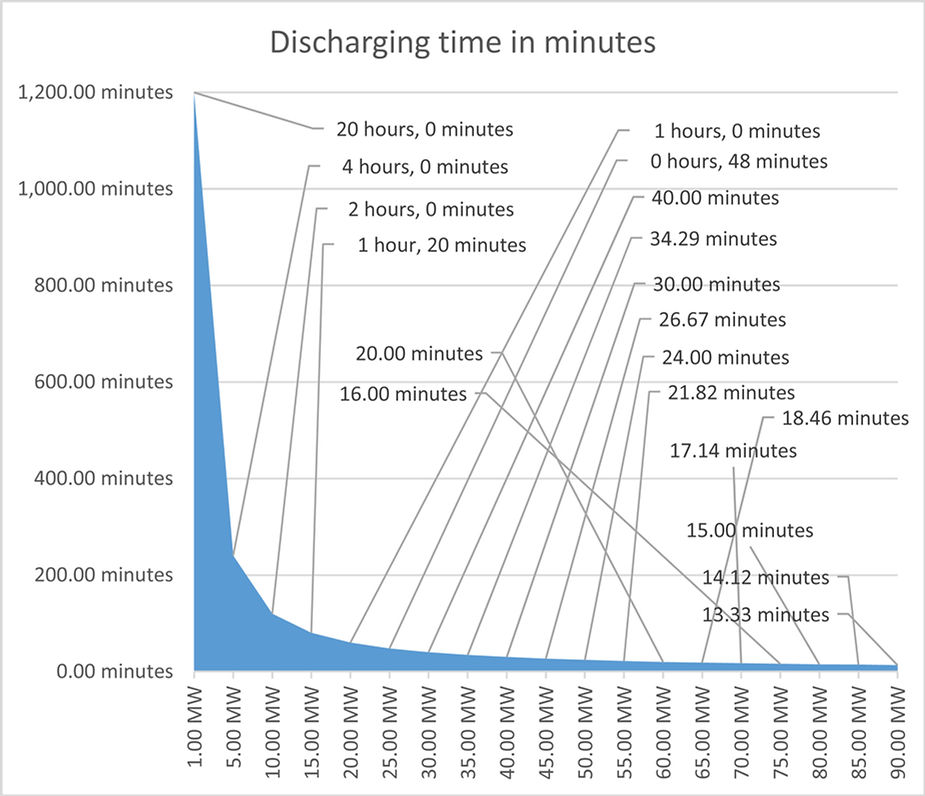
In contrast, the projects funded by the LCNF programme collectively provide 27.92 MWh of storage with a maximum power output of 16.55 MW. This is equivalent to 1 hour and 41 minutes of power if we assume 100% performance.

The Limitations of Traditional Energy Solutions
The potential of the TWEFDA Association is significant. However, when we compare it to Turlough Hill, a pumped hydro facility in Ireland, the differences become apparent.
This video illustrates Turlough Hill’s capabilities. It features a head of 286 m and holds 4 turbines, each with a capacity of 73 MW, totalling 292 MW. Each generator can reduce its output to 5 MW, allowing for flexible energy delivery. At maximum capacity, the four generators can operate at a flow rate of 111.3 m³/s, which means they can run for 5.5 hours before exhausting their capacity. This results in a total storage capacity of 1,606 MWh, which is indeed impressive.
While TWEFDA cannot compete directly with Turlough Hill’s 292 MW and 1,606 MWh capacity, it offers unique advantages. There is currently no single machine globally that can function both as a generator and a storage device on demand. The ability to ramp power up and down, both in terms of absorption and delivery, is remarkable.
The Innovation of ESWave Technology
The ESWave technology marks a historical milestone by harvesting what we refer to as ‘The Weight Changing Energy.’ This concept is backed by a peer-reviewed desktop proof of concept.
By harnessing four renewable energy sources, the ESWave effectively operates like having four machines in one.

The TWEFDA Hub features an integrated Energy Management and Control system. This system provides flexibility within a collaborative framework, allowing for efficient energy management.
The Dual Capacity of Generation and Storage
The dual capacity for generation or storage on demand is a game-changer. Supported by buoys and satellites, the TWEFDA system can deliver energy continuously, 24/7.
The ESWave creates a pumped-hydro application in the ocean, free from environmental constraints. It also takes advantage of the tidal range to enhance efficiency, a benefit not typically available in traditional pumped-hydro applications. By leveraging the tidal range, the overall performance can exceed 100%. For instance, the tidal range in the Bay of Fundy is 16 m.
Enhancing Storage Flexibility
Each ESWave device is equipped with two ballast tanks. These tanks can be filled with seawater either during the initial jacking stroke or after the device has been raised. Coupled with six pumps in the hub and a total of six devices, this setup offers extensive opportunities to adjust the storage process. This flexibility allows for effective management of power absorption and delivery, making it a compelling solution for addressing the variable oscillations in power required by the grid.
Pumped hydro applications are complex undertakings. A great example is the video titled 9 years in 12 minutes, which explores the construction of Limmen and is definitely worth a watch.
Conclusion: A Sustainable Future with TWEFDA
In conclusion, TWEFDA Limited is poised to revolutionise grid balancing. By becoming the leading provider of hybrid wave energy and storage solutions, we aim to significantly reduce carbon dependency. Our approach involves repurposing decommissioned assets to create a sustainable energy future.
The innovative ESWave technology, combined with our integrated management systems, positions us at the forefront of the energy transition. We are excited about the possibilities that lie ahead and are committed to leading the charge towards a greener, more sustainable energy landscape.