FROM OR TO AND.
One ESWave can generate or store. A TWEFDA Association distributes those roles across several machines so generation and storage can happen within the same coordinated offshore system.
TWEFDA ASSOCIATION: GENERATE AND STORE.
The Association is the point at which TWEFDA stops behaving like a single device and starts behaving like an energy system. Individual ESWaves can be assigned different functions according to grid signals, available energy, sea state and the needs of connected assets.
SIX ESWAVES. ONE COORDINATED SYSTEM.
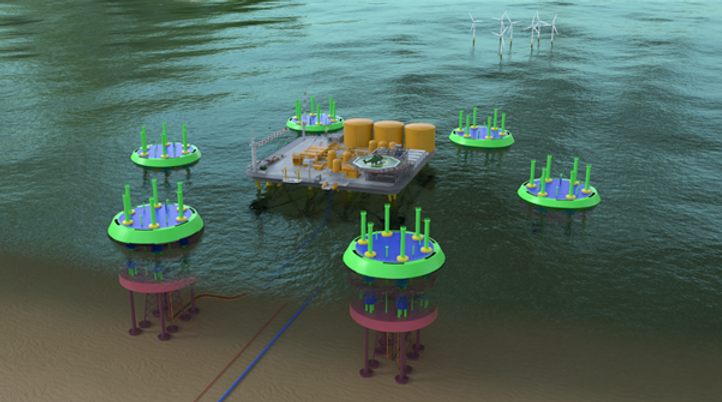
TWEFDA’s current reference architecture uses six ESWaves around a common facility. Six is a design reference, not a fundamental limit; the defining idea is distributed roles, shared equipment and coordinated control.
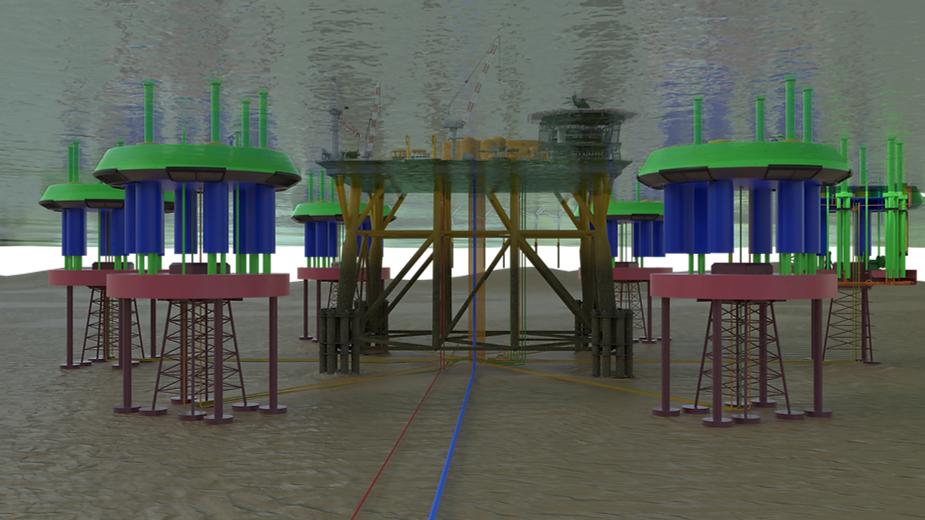
DIFFERENT MACHINES CAN DO DIFFERENT JOBS AT THE SAME TIME.
Generating
Some ESWaves can deliver renewable power while generation is valuable.
Accumulating
Some units can lock or accumulate energy in preparation for a later operating state.
Storing
Other units can receive energy and increase their gravitational potential at the same time.
THE ASSOCIATION IS A FLEET, NOT A COLLECTION.
Control is what turns several flexible machines into one responsive asset. Forecasts, grid requirements, storage state and ocean conditions can inform which ESWave should generate, accumulate, store or remain protected.
Forecast the resource
Wave and weather information can be used to anticipate low-resource periods or severe conditions rather than reacting only after they arrive.
Coordinate the response
Energy generated by one machine can be directed to another, creating internal energy flows as well as external delivery to the grid or connected assets.
SIX ESWAVES. THREE GENERATORS IN THE HUB.
The current TWEFDA Association concept removes the electrical generators from the six moving ESWaves and places three generators in the common TWEFDA Hub. This is not only a component-count decision. It allows the captured power of several ESWaves to be pooled before final electrical conversion.
3 SHARED GENERATORS.
CAPEX
The reference architecture requires three generator sets instead of six device-local generators, reducing duplicated high-value equipment.
OPEX
Fewer generator sets mean fewer machines to inspect, service and overhaul, with maintenance concentrated at the Hub rather than distributed across six moving devices.
Generator utilisation
In energetic seas, all three generators can share high aggregate power. In low-energy seas, the output of several ESWaves can be pooled through one generator while the remaining two stay idle, potentially keeping the active machine closer to a favourable operating region.
ESWave dynamics
ESWave is designed to work with a shared power-conversion system. Detailed technical information is available through controlled access, subject to an NDA and the applicable authorisation requirements.
THE SEA STATE CAN DECIDE HOW MANY GENERATORS NEED TO RUN.
Energetic sea
Six ESWaves can feed the common hydraulic/power system and the three Hub generators can operate together at high loading.
Calm sea
Lower power from several ESWaves can be aggregated and routed through a single generator. Two generator sets can remain idle rather than each operating inefficiently at low individual loading.
This turns the Hub into an active power-conversion manager, not just a structural connection point.
ENERGY CAN MOVE THROUGH THE ASSOCIATION.
One ESWave producing hydraulic or electrical energy can support another ESWave in increasing its stored gravitational energy. This is one of the reasons the Association is more than an array of identical generators.
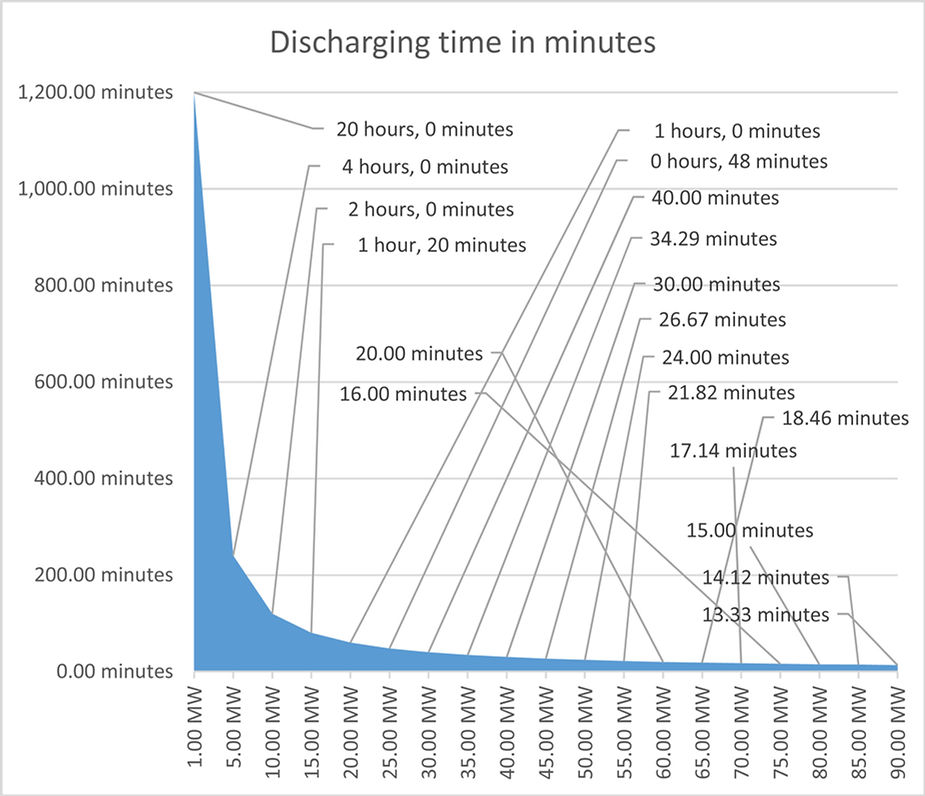
THE ASSOCIATION NEEDS A PLACE TO CONNECT, PROCESS AND COORDINATE ENERGY.
That is the role of the TWEFDA Hub.