THE GRID IS CHANGING.
THE ASSET SHOULD BE ABLE TO CHANGE WITH IT.
TWEFDA is exploring a controllable offshore energy architecture built around one question: what does the energy system need this asset to do now?
THE FLEXIBLE ENERGY ASSET
An individual ESWave can operate on the generation side or on the storage side of the system, using one physical platform and one PTO philosophy.
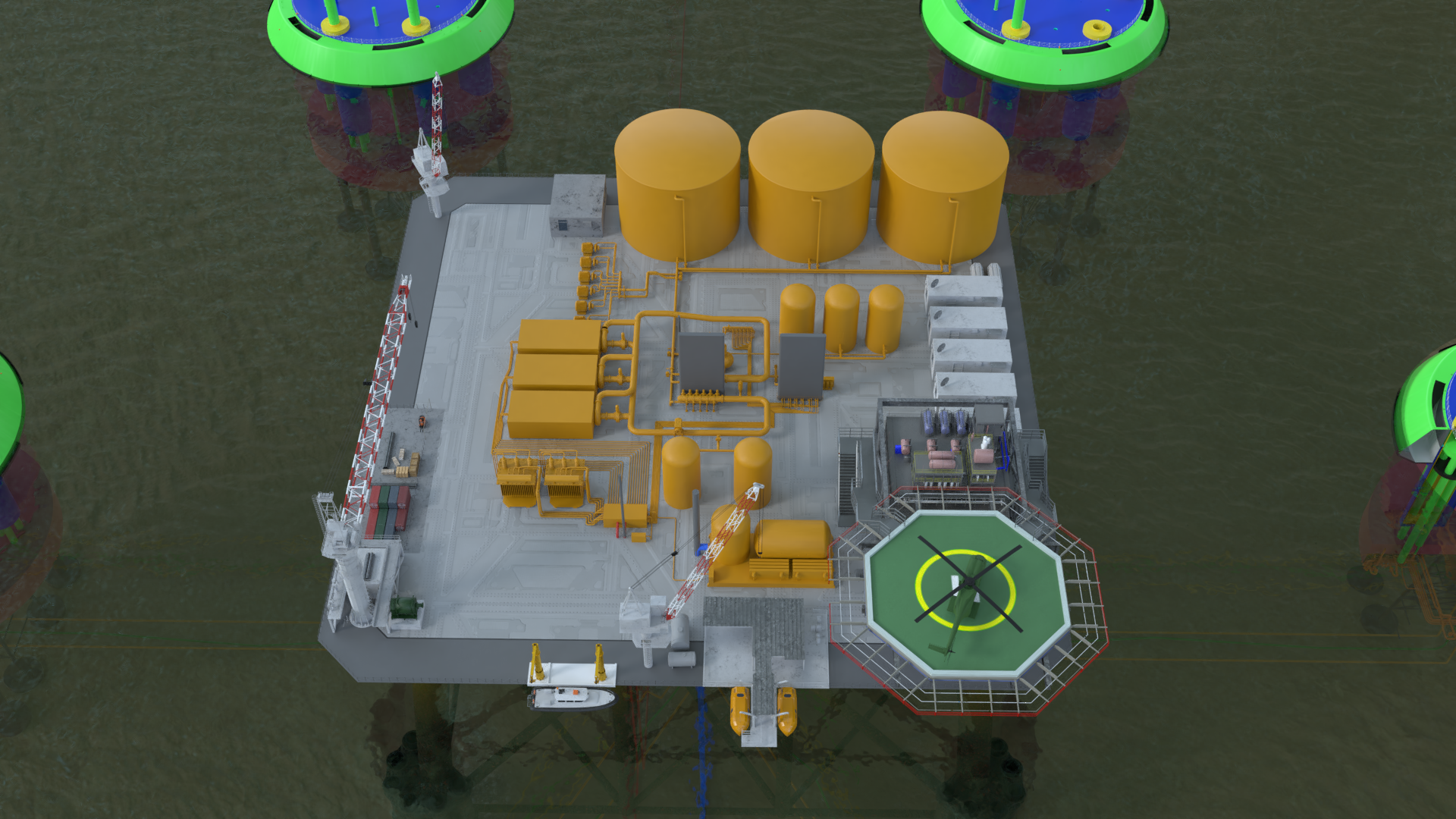
THE COORDINATION NODE
The Hub coordinates energy, assets, operating modes, data and connections so that the wider system can respond as conditions change.
THE COORDINATED ENERGY SYSTEM
Several ESWaves can perform different roles simultaneously. Some may generate while others accumulate or store, coordinated as one responsive energy system.
MORE RENEWABLE ENERGY IS NOT ENOUGH. FLEXIBILITY MATTERS.
The same megawatt can help or hurt the grid depending on when it appears. Generation and storage are valuable under opposite system conditions.
Generate
Additional supply can help restore balance.
Store
Absorption can become more useful than further generation.
Switch function
A fixed-role asset can remain on the wrong side of the system need.
FOUR APPLICATIONS FOR RENEWABLE ENERGY.
Four applications describe what the ESWave architecture is intended to do across generation and storage.
Wave Energy
Harvest energy from relative motion between the sea surface and a fixed reference.
Weight-Changing Energy
A non-reciprocal energy-conversion approach: what goes up differs from what goes down.
Offshore Pumped Hydro
Transform available power into stored gravitational energy offshore.
Tidal Range Energy
Coordinate gravitational-energy release with tidal variation to harvest an additional renewable contribution.
TWO COMPLEMENTARY GRID FUNCTIONS.
ONE PURPOSE: STAY ON THE USEFUL SIDE OF BALANCE.
An individual ESWave selects one function at a time. At Association level, different ESWaves can operate in different modes simultaneously while the Hub coordinates the aggregate response.
STORAGE IS NOT ONLY A TECHNICAL CHOICE.
IT IS A SOCIOECONOMIC ONE.
When people hear energy storage, they often think immediately of batteries.
ESWave stores energy differently: as gravitational potential. That changes not only the physics,
but also the resource story, supply-chain exposure and the possible energy balance of the storage cycle.
WITHOUT CONSUMING THE RESOURCE THAT STORES THE ENERGY.
WHAT DOES THE STORAGE SYSTEM DEPEND ON?
- Exposure to critical and active materials
- Concentrated global supply chains
- Commodity-price and procurement risk
- Degradation and replacement cycles
- Long-term operating economics
WHAT HAS TO BE EXTRACTED — AND UNDER WHAT CONDITIONS?
- Human-rights and labour concerns
- Mining and processing impacts
- Environmental burden
- Resource dependence
- Communities affected by extraction
STORAGE DOES NOT HAVE TO COME WITH A “BLOOD BATTERY” STORY.
For many stakeholders, the question is not only how much energy can be stored,
but what human and environmental story sits behind that storage.
ESWave offers a route in which the energy-storage medium itself
does not depend on battery active materials.
ESWave is not material-free and offshore infrastructure has its own environmental footprint.
Battery chemistries and supply chains also differ. The distinction here is specific:
ESWave’s storage mechanism does not use an electrochemical cell or a mineral active material
as the medium that stores the energy.
A STORAGE MODE THAT CAN BECOME A NET ENERGY EXPORTER.
Conventional storage is a net consumer of external energy over a charge–discharge cycle
because every conversion involves losses. ESWave introduces another possibility:
the same overall cycle can combine stored gravitational energy
with tidal-range energy harvested from the ocean.
100
+
OCEAN
→
>100
The additional energy comes from the tide.
Under favourable conditions, ESWave can therefore cross the line from
net external-energy consumer to net energy exporter
while performing its storage function. That is an unusual proposition for energy storage.
The opportunity becomes especially relevant where tidal range is exceptional.
In the Bay of Fundy, Nova Scotia, tidal ranges can approach 16 metres.
Reference · Parks Canada
DO WHAT THE GRID NEEDS NOW.
Generate
When incremental supply helps restore balance, ESWave can act on the generation side of the system.
Store
When further generation would worsen balance, the same asset can move to the absorption/storage side.
Switch
The useful question becomes: what does the energy system need this asset to be right now?
SHARE WHAT CAN BE SHARED. CONVERT ONLY WHEN THE SYSTEM NEEDS IT.
TWEFDA explores an architecture in which functions share physical infrastructure where that reduces unnecessary duplication and conversion stages.
Share conversion where possible.
A common physical architecture and single-PTO philosophy can serve selectable energy functions rather than duplicating two unrelated plants.
Do not convert energy before it is needed.
Keeping energy in a useful mechanical or gravitational form until electricity is required can avoid conversion stages that otherwise add losses and equipment.
WEIGHT-CHANGING ENERGY
Our technology explores an energy-conversion mechanism within known physical laws in which what goes up behaves differently from what goes down.
Weight-Changing Energy is at the computational proof-of-concept stage. The concept explores a non-reciprocal response: the converter behaves differently during ascent and descent.
Preliminary simulations indicate substantial potential to improve power capture compared with a fixed-weight configuration. Physical validation is the next decisive step.
An improvement of this kind could make a meaningful difference to the commercial viability of wave energy. Detailed technical information is available through controlled access, subject to an NDA and the applicable authorisation requirements.
FROM IN SILICO PROOF TO PHYSICAL VALIDATION.
TWEFDA is at an early validation stage. Weight-Changing Energy has reached an in silico proof of concept for a non-reciprocal energy-conversion mechanism, supported by preliminary hydrodynamic analysis. Physical validation remains the next decisive evidence.
Approx. TRL 3
Computational proof of concept and preliminary technical analysis.
Physical validation
Prototype development, controlled wave-tank testing and progressive validation.
Evidence before scale
Each development stage should retire a specific technical or commercial risk before the next stage of capital.
THE VISION IS AMBITIOUS.
THE FIRST STEP IS DELIBERATELY FOCUSED.
TWEFDA is not attempting to commercialise its entire technology platform at once. WaveAmp is the first commercialisation stage, focused on Weight-Changing Energy in Europe.
WaveAmp
A focused route to physical validation and European market entry for Weight-Changing Energy.
Reduce the first challenge — not the opportunity.
WaveAmp narrows the first commercial objective without narrowing the wider TWEFDA technology platform.
ONE TECHNOLOGY PLATFORM. VALUE ACROSS FOUR DIMENSIONS.
The opportunity extends beyond a single performance metric. TWEFDA has historically grouped its value propositions into Social, Technical, Environmental and Economic dimensions.
Better use of shared energy infrastructure.
- Grid imbalance has a social cost.
- Flexibility can help make better use of renewable generation.
- Suitable offshore infrastructure may retain useful value.
Value created by architecture and control.
- Four applications support two complementary functions.
- The same asset can change role according to system need.
- An Association can coordinate several ESWaves.
Value beyond renewable generation alone.
- Generation, storage and flexibility can support variable renewables.
- Repurposing may reduce the need for new structures where technically suitable.
- Gravitational storage reduces reliance on electrochemical battery materials for that function.
One asset used in more useful ways.
- Value can be created on either side of the balancing problem.
- Shared conversion can reduce duplicated equipment.
- Staged commercialisation narrows the first capital challenge.
FROM THE SYSTEM PROBLEM TO THE ENERGY MACHINE.
Continue with Generation & Storage for a closer comparison of specialised assets, storage machines and TWEFDA’s Generate OR Store on Demand proposition.