BALANCE IS THE LAW.
The Blue Economy is emerging as the next great link to explore. TWEFDA has much to contribute—not by adding another isolated asset, but by helping balance offshore generation and demand through an interconnected, multifunctional energy system.
The TWEFDA Association connected to offshore wind, other Hubs forming power rings, offshore consumers and wider grids—the system idea before the visitor reaches the detail.
The offshore problem is balance
Variable generation, changing demand, isolated assets, legacy infrastructure and long connection routes create a system problem—not simply a capacity problem.
By building an energy puzzle
ESWave provides flexibility. The Association coordinates functions. The Hub attracts and interconnects generation, storage, consumers and other grids around a common node.
Not another asset: a system
TWEFDA proposes a complete, interconnected and multifunctional energy system designed around one mission: balance the grid.
FLEXIBILITY IS NOT “MORE”. IT IS THE ABILITY TO DO WHAT THE SYSTEM NEEDS.
The conversation changes when we stop asking how much energy we can add and start asking what the grid needs at each moment.
Carbon Trust and Imperial College analysis found that a fully flexible energy system could deliver material net savings of £9.6–£16.7 billion per year in 2050, with flexibility delivering value across all three heat-decarbonisation scenarios analysed. Carbon Trust describes flexibility as a “no regrets” action that needs investment now.
[1] Carbon Trust · Flexibility in Great Britain · [2] Andrew Lever · reference video
Value changes with time
Renewable generation does not always coincide with demand. The value lies in responding to that mismatch, not in generating for generation's sake.
Complementary functions
The same ESWave is conceived to move between complementary generation and storage functions, allowing a different mission to be assigned as system conditions change.
An asset that responds
The machine stops being a one-function source and becomes a flexible resource serving balance.
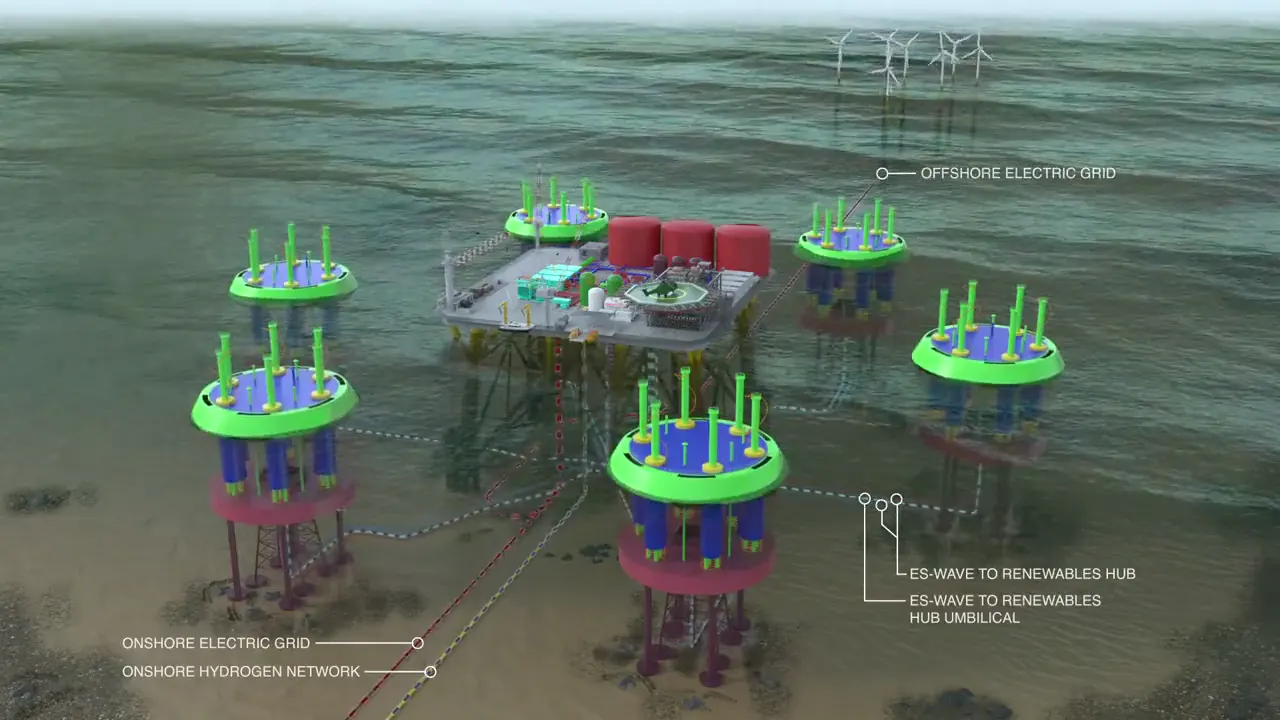
TWEFDA Association (TWA): coordinated ESWaves around the Hub. The moving version is now placed in the hero so the system idea appears immediately.
ONE FLEXIBLE MACHINE HELPS. SEVERAL COORDINATED MACHINES CAN BALANCE AS A SYSTEM.
The Association turns individual capabilities into collective behaviour. It does not force every ESWave to do the same thing; it allows functions to be distributed over time.
The grid needs coordination
Power without coordination does not resolve the mismatch between resource, demand and time.
By distributing functions
Some ESWaves can generate while others store, accumulate or remain ready for the system's next requirement.
A coordinated energy system
The Association turns individual devices into a collective capability able to respond with more than one function.
THE HUB DOES NOT CLOSE TWEFDA OFF. IT OPENS THE SYSTEM TO OTHERS.
TWEFDA is not trying to build a technological island. The Hub is a magnet around which the grid can assemble an energy puzzle: offshore wind, wave, floating solar, storage, offshore consumers, existing infrastructure and other Hubs can all become pieces when they contribute to balance.
Value is fragmented
Assets sharing the same sea, infrastructure and energy needs can still remain functionally disconnected.
Through a common node
The Hub can integrate power, data and control and bring the connection point closer to offshore assets, potentially shortening cable routes, reducing exposure and improving connectivity where the architecture allows.
A magnet for collaboration
The Hub is deliberately open: any compatible source, store or load that improves balance can have a place in the puzzle.
BRING THE CONNECTION POINT CLOSER. REDUCE EXPOSURE. CREATE BALANCE.
In offshore wind, the export connection is not a secondary detail. Distance to cable landfall materially affects project cost, while subsea cables are one of the largest sources of insured loss. TWEFDA's Hub can act as an offshore integration point between production, storage, offshore demand and the onshore grid.
Long export routes increase cost, exposure and consequence of failure
Offshore wind is variable and often far from demand. Longer point-to-point export routes require more cable and create more exposed asset length. Allianz notes that as wind farms grow with more and longer cables, the probability of damage increases. A failure on an export cable can interrupt a whole group of turbines.
Use the Hub as a closer offshore connection and balancing point
The Hub can integrate offshore wind with flexible ESWave generation and storage, the TWEFDA Association, local offshore consumers and the wider grid. Where project layout allows, bringing the integration point closer can shorten or rationalise some cable routes, reduce exposure and create more options for balancing energy before it travels onshore.
IEA Wind Task 26 / ORE Catapult used an export-cable assumption of €800/m; increasing cable length from 10 km to 120 km added €88m of capital cost in that model. Allianz reports that cable damage/failure represented 53% of offshore-wind claims by value in its Germany and Central/Eastern Europe portfolio, and explicitly links more and longer cables with higher probability of damage.
[3] IEA Wind Task 26 / ORE Catapult · [4] Allianz Commercial · [5] Carbon Trust · Cable Burial Risk
Insurance note: there is no credible simple premium-per-kilometre rule. Underwriters assess cable type, route, burial, seabed, installation, contractors, repair strategy, vessels, certification and other project-specific controls. Length increases exposure, but it is one input to the risk—not the whole price.
An integration layer between offshore production, local consumption, storage and the onshore grid
TWEFDA is not another generator to connect at the end of a long cable. It is an architecture designed to connect and coordinate offshore wind, flexible generation and storage, consumers and other Hubs before energy is routed to shore or into wider grids. Its purpose is to make the offshore system easier to balance and easier to interconnect.
FROM CONNECTING COUNTRIES TO BUILDING OFFSHORE ENERGY NODES.
Interconnectors already move electricity between markets. Offshore Hybrid Assets go further by combining offshore-wind transmission with cross-border interconnection. TWEFDA asks the next question: what if the same offshore node could also help balance generation, storage and demand before electricity decides where it needs to go?
Cross-border links already help balance supply and demand
Interconnectors move electricity in response to differences between markets. Ofgem reports that, in the year to September 2025, Great Britain imported about 43 TWh and exported about 12 TWh through interconnection, describing that cross-border trading as crucial to balancing supply and demand.
Transmission and offshore wind are starting to become one coordinated asset
NESO defines an Offshore Hybrid Asset as infrastructure that integrates the network connection for offshore wind with an interconnector. National Grid describes the same transition more visually: instead of each wind farm and interconnector connecting separately to shore, the offshore node becomes a shared connection hub.
The Hub could add a balancing layer at the node
TWEFDA does not need to replace the interconnector. The distinctive opportunity is to place the Hub concept at or around the same offshore node, where ESWave flexibility, Association coordination, storage, local demand and other compatible assets can interact with transmission.
10 operational interconnectors
Ofgem says Great Britain is currently connected to seven neighbouring markets through ten operational links.
GB ↔ Netherlands + offshore wind
National Grid describes LionLink as a first-of-its-kind step toward an integrated North Sea grid, connecting offshore wind to both national systems.
GB ↔ Germany + wind on both sides
National Grid and TenneT Germany are exploring a multi-purpose interconnector designed to connect British and German offshore wind to both electricity systems.
OHA cases with higher NPV
In one 2031 Leading the Way comparison, 10 of 15 OHA cases had higher NPV than their point-to-point equivalents; five moved from negative to positive NPV.
“THERE IS NO ENERGY TRANSITION WITHOUT TRANSMISSION.”
Matt Hinde, National Grid — from the video supplied for this TWEFDA research. The exact attribution comes from that supplied video; current National Grid, NESO and Ofgem material independently confirms the wider move toward coordinated offshore transmission and hybrid assets.
AN INTERCONNECTOR MOVES ENERGY. AN OHA COMBINES TRANSMISSION WITH OFFSHORE WIND. TWEFDA'S HUB COULD ADD BALANCE AT THE NODE.
The regulated OHA concept and the TWEFDA Hub are not the same asset. The significance is architectural: the market is already moving toward offshore nodes that combine generation and cross-border transmission. TWEFDA's proposition is to add multifunctional balancing around that node—generation, storage, demand, other resources and other Hubs—so the connection becomes part of a broader energy system.
Positioning note: TWEFDA is not presented here as a regulated Offshore Hybrid Asset, interconnector owner or transmission operator. The opportunity described is a potential integration role around the offshore node, subject to technical, commercial and regulatory development.
[6] NESO · Offshore Hybrid Assets · [7] Ofgem · Interconnection · [8] NESO · Interconnector Analysis 2024 · [9] National Grid · LionLink · [10] National Grid · GriffinLink · [11] Matt Hinde · supplied video
ONCE THE NODE EXISTS, THE BLUE ECONOMY CAN SHARE MORE THAN ENERGY.
Infrastructure, location, access, data and offshore services can create opportunities for collaboration far beyond a single electricity market.
Resources do not end at the cable
An offshore location, structure, logistics access or environmental monitoring can retain value for other activities.
By sharing the node
The Hub can become a meeting point for activities that need energy, access, data, infrastructure or common services.
A collaborative ecosystem
Aquaculture, desalination, R&D, monitoring, hydrogen, logistics and energy trading are examples historically considered by TWEFDA.
Aquaculture
Marine cultivation in compatible locations.
Desalination
Local energy and seawater access.
R&D
Offshore testing and demonstration.
Monitoring
Ocean, weather and ecological data.
Hydrogen
Production, storage or refuelling where justified.
Offshore vessel charging
Electricity or hydrogen for vessels without having to enter a harbour, where project design, safety and regulation make it viable.
Energy trading
Interconnection and future energy routes.
Shared logistics
Common access, maintenance and support.
Future uses
Preserving options as markets emerge.
THE NEXT STEP IS NOT SCALE FOR SCALE'S SAKE. IT IS COORDINATION.
One Hub connects local assets. Multiple Hubs can begin to connect systems. The same balancing logic can extend from one machine to an Association, from the Association to a node, and from the node to an interconnected offshore grid.
The Blue Economy does not end at one location
Ports, offshore farms, platforms, consumers and countries belong to a common energy geography.
By interconnecting Hubs
Other Hubs can become sources or destinations of energy and form power rings and alternative routes.
A multifunctional grid
An architecture capable of coordinating generation, storage, consumption and infrastructure without requiring one technology to do everything.
TWEFDA DOES NOT BRING ONE MORE ASSET.
It brings a proposal for a complete, interconnected and multifunctional energy system: ESWave provides flexibility, the Association coordinates that flexibility, and the Hub connects it with everything that can help the grid.
From machine to system. From system to node. From node to network. The word does not change.
The narrative above reorganises the vision around balance. Open the exact Resources replica →